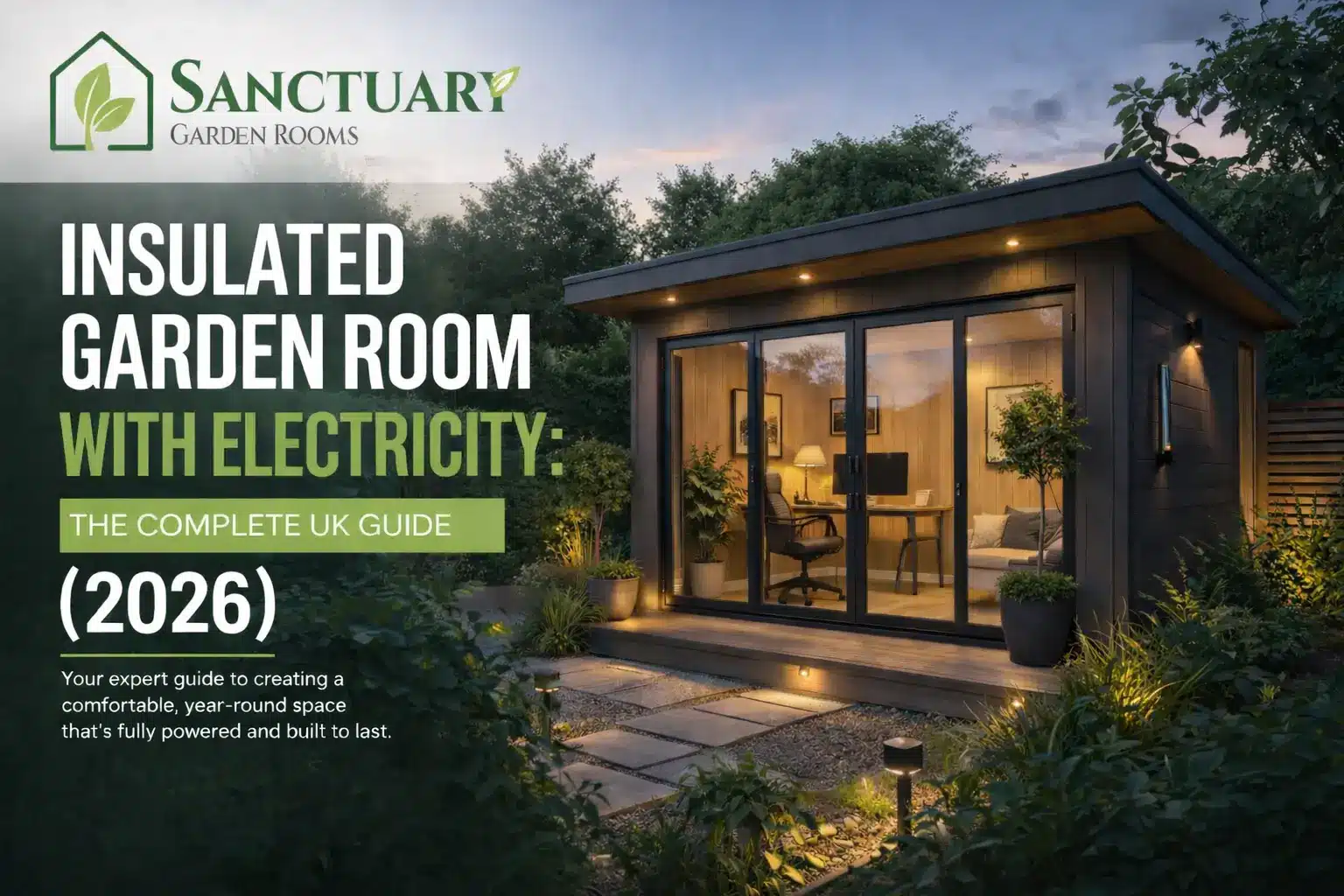
Insulated Garden Room With Electricity: The Complete UK Guide (2026)

Thinking about adding a garden room to your property in 2026? If you want a space that genuinely works for you every single day of the year, not just on warm summer afternoons, then an insulated garden room with electricity is not an optional upgrade. It is the foundation of a space that is actually worth building.
At Sanctuary Garden Rooms, we have been designing and building bespoke, fully insulated garden rooms for over 20 years. In this guide, we cover everything you need to know about insulation, electricity, planning, and what makes a garden room truly year-round, without a single compromise.

What Is an Insulated Garden Room With Electricity?

An insulated garden room with electricity is a purpose-built, standalone garden structure that combines high-performance thermal insulation with a permanent, certified mains electrical supply. Unlike a basic summer house or timber shed, which are only usable in mild weather, an insulated garden room is a genuine year-round space, warm in winter, cool in summer, and fully powered for everything your daily routine demands.
The structure is built with insulation integrated into the walls, floor, and roof, using the same construction principles as a small residential building. Add an electrical connection, and the space becomes indistinguishable from a room inside your home, except it sits at the bottom of your garden.

Why Insulation and Electricity Must Work Together

Insulation and electricity are not separate considerations, they are two halves of the same solution. Without proper insulation, electric heaters run constantly, energy bills rise, and the space never quite reaches a comfortable temperature. Without electricity, even the best-insulated garden room has no lighting, no heating, and no practical functionality.
Together, they create a thermally stable, fully functional environment that works regardless of the British weather. Here is why both matter:

What Insulation Does for Your Garden Room

Maintains a stable internal temperature, warm in winter, and comfortable in summer.
Prevents condensation forming on walls and floors, protecting both the structure and any equipment inside.
Reduces acoustic noise from the outside, ideal for a focused home office or music studio.
Significantly lowers heating energy consumption, a well-insulated room retains heat far longer than an uninsulated structure.
Protects delicate items, electronics, instruments, furniture and fabrics all degrade quickly in damp, uninsulated spaces.

What Electricity Enables in Your Garden Room

Lighting: Essential for early mornings and winter evenings when UK daylight hours are limited.
Heating: Electric panel heaters, infrared panels or underfloor heating to maintain comfort in cold months.
Power for work: Sockets for laptops, monitors, printers and phone charging.
Broadband connectivity: Whether via a hardwired ethernet cable or a mains-powered Wi-Fi extender.
Security: External lighting, alarm systems and smart locks.
Appliances: A small fridge, coffee maker, or air conditioning unit if required.
Expert Tip: Always plan your electrical layout before the build begins. Retrofitting additional circuits or cable routes after the structure is complete is significantly more expensive and disruptive. At Sanctuary Garden Rooms, we discuss your electrical requirements at the free site survey stage so everything is designed in from day one.

The Best Insulation Types for UK Garden Rooms in 2026

Not all insulation performs equally. The type of insulation used in your garden room directly affects its thermal performance, internal dimensions, long-term comfort, and value. Here are the main options used in the best insulated garden rooms in the UK:
Insulation Type Typical Thickness Best U-Value Best For
SIPs (Structural Insulated Panels) 100–150mm 0.15 W/m²K Premium builds for maximum performance
Rockwool / Mineral Wool 75–150mm 0.25 W/m²K Acoustic priority for studios and music rooms
Spray Foam Variable 0.22 W/m²K Retrofit situations that fill irregular gaps

PIR Board — The Gold Standard for UK Garden Rooms

PIR (Polyisocyanurate) board insulation is the most widely specified insulation in quality for UK garden rooms in 2026. It delivers exceptional thermal performance in a slim profile, which is critical in garden room construction where wall thickness directly reduces internal space. A 75mm PIR board in the wall, floor, and roof is typically sufficient to achieve year-round comfort in the British climate.

SIPs — The Premium Choice

Structural Insulated Panels (SIPs) are factory-manufactured panels with rigid foam insulation bonded between two structural boards. They achieve the highest thermal performance of any option, with excellent air-tightness and fast on-site assembly. This is suitable for homeowners in the UK who want the absolute best in thermal performance and build precision.

Rockwool — When Acoustic Performance Matters

If your garden room will be used as a music studio, podcast recording space, home cinema, or any environment where sound management is a priority, Rockwool mineral wool insulation offers excellent acoustic absorption alongside its thermal properties. It requires a deeper wall cavity than PIR, which slightly reduces internal dimensions, but the acoustic benefit is significant.

How Electricity Is Connected to a Garden Room in the UK

Connecting electricity to a garden room is a straightforward process when planned correctly and carried out by a qualified, Part P-certified electrician. Here is an overview of how the electrical installation works:

Step 1: Route the Armoured Cable

A steel wire armoured (SWA) cable is run from the main consumer unit inside your house, underground across the garden, and into the garden room. The cable must be buried at a safe depth, typically 450mm minimum, or 600mm under areas where digging might occur. The route is usually marked with warning tape to protect it from accidental damage in future.

Step 2: Install a Sub Consumer Unit

A dedicated sub consumer unit (fuse board) is installed inside the garden room. This provides circuit protection for all the electrical circuits in the building, lighting, sockets, heating, and any other circuits you require. The sub board is connected back to the main house board via the armoured cable.

Step 3: First Fix Wiring

Before insulation and internal lining are installed, all wiring is run through the structure, sockets, light fittings, heating connections, TV and data points. This first-fix stage is critical to get right, as accessing wiring after the internal lining is installed is difficult and costly.

Step 4: Second Fix and Testing

Once the internal lining is complete, all sockets, switches, light fittings and heating controls are fitted. The installation is then tested, certified, and signed off under Part P of the Building Regulations. You receive a certificate, this is important for insurance purposes and is required if you ever sell your property.

Year-Round Uses for an Insulated Garden Room With Electricity

One of the most compelling reasons to invest in a properly insulated, electrically connected garden room is the sheer versatility of the space. Because the room is comfortable in every season and fully powered, it can serve an almost unlimited range of purposes, and those purposes can change over time as your lifestyle evolves.

Garden Home Office

The most popular use in 2026, driven by the sustained growth of remote and hybrid working across the UK. A properly insulated garden office provides a genuine separation between home life and work life, something a spare bedroom simply cannot replicate. The physical act of walking to the bottom of the garden creates a psychological transition that improves focus, reduces stress, and makes it significantly easier to switch off at the end of the working day.
Studies consistently show that remote workers with a dedicated workspace outside the home report higher productivity and better work-life balance than those working from a kitchen table or shared living space.

Creative Studio

Whether you paint, sculpt, do photography, record music, or create digital content, an insulated garden studio gives you a permanent, dedicated creative environment that can be set up exactly as you need it and left that way between sessions. No more packing away the easel at mealtimes or losing your setup between recording sessions.

Home Gym

A garden gym is one of the fastest-growing uses for garden rooms across the UK. With full insulation keeping the space comfortable year-round, you have no excuse to skip a session regardless of the weather outside. Electricity powers lighting for early mornings and evenings, a sound system for motivation, and a wall-mounted fan or air conditioning unit for warm summer workouts.

Garden Office With Treatment Room

For beauty therapists, massage practitioners, physiotherapists and other wellness professionals, a garden treatment room provides a private, professional client-facing space without the overhead of commercial premises. Electricity is essential for treatment equipment, lighting, heating, and music, all of which can be planned into the electrical specification from the outset.

Guest Suite or Garden Studio

With proper insulation, electricity, and plumbing (which may require planning permission), a garden room can become a comfortable and private guest suite. Homeowners across the UK are increasingly building insulated garden studios that double as guest accommodation and secondary workspace, a genuinely versatile investment.

Planning Permission for an Insulated Garden Room With Electricity

One of the most significant advantages of a garden room over a house extension is that, in most cases, planning permission is not required. Insulated garden rooms with electricity typically fall under Permitted Development rights, provided the structure meets the following criteria:

The building is single-storey with a maximum eaves height of 2.5 metres
The overall height does not exceed 4 metres (pitched roof) or 3 metres (flat/other roof)
The garden room does not cover more than 50% of the total land area surrounding the original house
The structure is not positioned forward of the principal elevation of the house
The building is not intended for use as a separate dwelling or sleeping accommodation

Adding electricity to a garden room does not affect its planning permission status. However, if you live in a conservation area, an Area of Outstanding Natural Beauty (AONB) or a National Park, or if your property is a listed building, Permitted Development rights may be restricted and planning permission could be required.

Expert Tip: Always confirm the planning status with your local planning authority before starting any build. Sanctuary Garden Rooms can advise on this during your free, no-obligation site survey, it is one of the first things we discuss.

What About Building Regulations?

Garden rooms under 30m² and not used for sleeping accommodation are generally exempt from full Building Regulations in the UK. However, all electrical installation work must comply with Part P of the Building Regulations, which means it must be carried out by a certified electrician and signed off with a completion certificate. This is non-negotiable and critical for your home insurance and any future property sale.

Key Features to Look For in the Best Insulated Garden Rooms UK

With dozens of garden room suppliers now operating across the UK, knowing what separates a genuinely high-quality build from a budget option is essential. Here is what the best insulated garden rooms in the UK have in common in 2026:

Foundation Quality

The foundation is the most important structural component of any garden room. Concrete pile foundations, the method used by Sanctuary Garden Rooms, provide superior stability and longevity compared to cheaper timber post bases, which are susceptible to movement and rot. A quality foundation protects your investment for decades.

Insulation Specification

Look for a minimum U-value of 0.22 W/m²K or lower across walls, floor and roof. This is the thermal performance threshold that ensures genuine year-round comfort in the UK climate. Any supplier who cannot provide a U-value specification should be treated with caution.

Glazing Standard

Double glazing is the minimum acceptable standard for an insulated garden room intended for year-round use. Low-emissivity (low-E) glass coating significantly improves thermal performance by reducing heat loss through the glass. Thermally broken aluminium frames, used in all Sanctuary Garden Rooms builds, prevent cold bridging at the frame junction, which is a common weakness in lesser builds.

Cladding and Roof

The external cladding protects the insulated structure from the British weather. Siberian larch and Western Red Cedar are the most popular premium timber options, both offering excellent durability and natural beauty that weathers elegantly over time. EPDM rubber membrane roofing is the most durable flat roof specification, maintenance-free and with a lifespan of 25 years or more when correctly installed.

Electrical Specification

A quality garden room electrical installation should include: a steel wire armoured (SWA) cable connection to the house consumer unit, a dedicated sub consumer unit with RCD protection, a minimum of 5-8 double sockets, LED lighting on a separate circuit, a heating circuit, and an external security light. All work must be Part P certified.

Warranty

The structural warranty is your long-term protection. One of the strongest guarantees in the industry. Always ask for the warranty in writing before committing to any supplier.

Insulated Garden Rooms for Small Gardens: What You Need to Know

A common misconception is that a quality insulated garden room requires a large garden. Let us bust the myth here. The key is thoughtful design.

Design Strategies for Small Gardens

Mono-pitch or flat roof: Keeps the overall height low while maximising internal headroom.
Position close to the boundary: Permitted Development allows placement within 1m of a boundary at up to 2.5m eaves height
Full-height glazing: Makes a small garden room feel significantly larger and floods the interior with natural light
Light external cladding: Pale cedar or grey composite reflects light and reduces visual mass
Built-in joinery: Eliminates bulky freestanding furniture and maximises every square centimetre of floor space
Even in a compact garden, an insulated garden room with electricity can comfortably accommodate a standing desk, ergonomic chair, full shelving unit, and small sofa, everything you need for a productive, comfortable working day.

Modern Garden Room Design Ideas for 2026

The garden room aesthetic has evolved significantly. In 2026, the most desirable insulated garden rooms combine high thermal performance with strong architectural design, creating spaces that are as beautiful to look at from the house as they are to work in. Here are the most popular design directions we are seeing:

Dark Cladding With Large Glazing

Charcoal, anthracite, or near-black timber cladding paired with full-height aluminium bi-fold or sliding glass doors is the dominant contemporary aesthetic across the London. The dark exterior creates a striking contrast against garden planting, while the large glazing floods the interior with natural light and creates a seamless connection to the garden when the doors are open.

Natural Cedar With Mono-Pitch Roof

A classic contemporary combination, natural Siberian larch or Western Red Cedar cladding weathering to a beautiful silver-grey over time, paired with a clean mono-pitch (lean-to) flat roof finished with EPDM rubber membrane. This profile sits well in most of the gardens in the UK, keeping a low visual profile while delivering generous internal volume.

Green Roof With Sustainable Materials

Sedum or wildflower green roofs are increasingly popular in urban gardens across London, where they contribute to biodiversity, improve rainwater management, and create a striking visual connection between the garden room and the surrounding planting. Paired with FSC-certified timber cladding and triple glazing, this creates the most environmentally considered garden room specification available.

Scandi Minimalist Interior

Inside, the most popular 2026 interior aesthetic is a clean, calm Scandinavian-inspired palette — pale plywood or whitewashed pine wall lining, polished concrete or engineered oak flooring, built-in desk and shelving in natural timber, and warm LED lighting on dimmer switches. The result is a space that genuinely inspires creativity and focused work.

How to Choose the Right Garden Room Company in the UK

The quality of your insulated garden room is ultimately determined by the company you choose to build it. With the market now crowded with suppliers ranging from premium bespoke builders to low-cost flat-pack kit manufacturers, knowing how to evaluate your options is critical.
Here are the questions to ask every supplier before committing:

Do they carry out all work themselves, or do they subcontract? (Subcontracting increases risk)

Is electrical installation included in the price, or is it a separate cost?

What insulation specification do they use, and what U-value does it achieve?

What is their foundation method, concrete piles or timber posts?

What structural warranty do they provide, and is it backed in writing?

Can they provide references and photographs of recent completed builds in your area?

Is the electrical installation Part P certified, and do you receive a certificate on completion?

Do they offer a free no-obligation site survey before any commitment?

Book Your Free Site Survey With Sanctuary Garden Rooms

If you are ready to explore an insulated garden room with electricity for your property in the UK, Sanctuary Garden Rooms would be delighted to help. Our free, no-obligation site survey is the ideal starting point, we visit your garden, discuss your requirements in detail, advise on design, positioning, and planning, and provide a full written quotation.

There is no pressure and no cost. Just expert advice from a team with over 25 years of experience in building exceptional garden rooms. Get in touch today!
Frequently Asked Questions

Does an insulated garden room with electricity need planning permission in the UK?
In most cases, no. Insulated garden rooms with electricity fall under Permitted Development rights in the UK, meaning planning permission is not required, as long as the structure meets the standard criteria: under 2.5m at the eaves, does not cover more than 50% of the garden, and is not positioned in front of the house. Adding electricity does not affect planning status. However, if you live in a conservation area, an AONB, or a listed building, different rules apply, always check with your local planning authority or ask Sanctuary Garden Rooms to advise at your free site survey.
What is the best insulation for a UK garden room in 2026?
PIR (Polyisocyanurate) board insulation is the most widely recommended choice for UK garden rooms in 2026. It offers an excellent U-value (0.18–0.22 W/m²K) in a slim profile, maximising internal space while delivering genuine year-round thermal comfort. For the very highest performance, particularly in premium or large builds, Structural Insulated Panels (SIPs) are the gold standard. At Sanctuary Garden Rooms, we use PIR board insulation as standard in all walls, floors, and roofs, with SIPs available as an upgrade.
Can I use an insulated garden room all year round?
Yes, that is the primary purpose of specifying high-performance insulation. A properly insulated garden room with a certified electrical supply and electric heating will maintain a comfortable, stable temperature throughout the year, including during UK winters. Our customers use their garden rooms every day of the year, regardless of the weather. The combination of PIR insulation, EPDM roofing, thermally broken double glazing, and electric heating means there is no season in which the room is not comfortable.
Does a garden room need to be connected to the mains for electricity?
Yes, for a safe, functional, and insurance-compliant installation, a garden room must be connected to the mains electricity supply via a steel wire armoured (SWA) cable run underground from the main house consumer unit. This is the only approach that allows a dedicated sub-consumer unit, RCD circuit protection, certified wiring, and a Part P completion certificate. Extension cables run across the garden surface are not a safe, compliant or permanent solution and should never be used as a substitute for a proper mains connection.
Will an insulated garden room with electricity add value to my home?
Yes. A quality insulated garden room with electricity consistently adds value to UK properties. Estate agents across Surrey and London report that homes with a quality garden room, particularly one with a certified electrical installation, attract stronger buyer interest and achieve higher sale prices. Research indicates that a well-specified garden room can add between 5% and 15% to a property's market value. In high-demand areas like Surrey, Guildford and Greater London, the return on investment is typically at the higher end of this range.
Is a prefab garden room or a bespoke build better for insulation and electricity?
Both prefab and bespoke garden rooms can be well-insulated and properly wired, but there are meaningful differences. Prefab options offer faster delivery and installation, but are limited to the manufacturer's fixed size and specification ranges. Electrical installation is often a separate cost with prefab products. A bespoke build, like those from Sanctuary Garden Rooms, is designed specifically for your garden, your requirements, and your aesthetic preferences, with insulation, glazing, and electrical specifications built in from the start. For homeowners who want the best long-term result, a bespoke insulated garden room consistently outperforms a prefab option on build quality, thermal performance, and added property value.

Do I need building regulations approval for a garden room with electricity?
Garden rooms under 30m² used as non-habitable spaces (office, gym, studio) are generally exempt from full Building Regulations in the UK. However, the electrical installation must comply with Part P of the Building Regulations regardless of the size or use of the garden room. This means all electrical work must be designed and installed by a Part P-certified electrician, tested, and signed off with a completion certificate. This certificate is essential for your home insurance and must be provided to any future buyer of your property. At Sanctuary Garden Rooms, all electrical work is carried out by our own certified team, and you receive your Part P certificate on completion.