Table of Contents
ToggleGarden Room vs Home Extension: Which One Actually Adds More Value to Your Property in the UK?
A neighbour knocks down a wall and builds out the side of their house. You, meanwhile, put up a stunning garden room at the bottom of the garden. Six months later, you are both selling, whose estate agent is smiling wider?
That’s not a trick question. But the answer might surprise you. The garden room vs home extension debate has been running for years, and with UK property prices, planning rules, and building costs all shifting, 2026 is probably the most important time to actually get this comparison right.
In this blog, we are going to walk through exactly that, costs, planning permission headaches, return on investment, how lenders view each option, and ultimately, which one adds more value to your UK property. Whether you are in it for the resale price or just want more usable space without the drama, stick around.
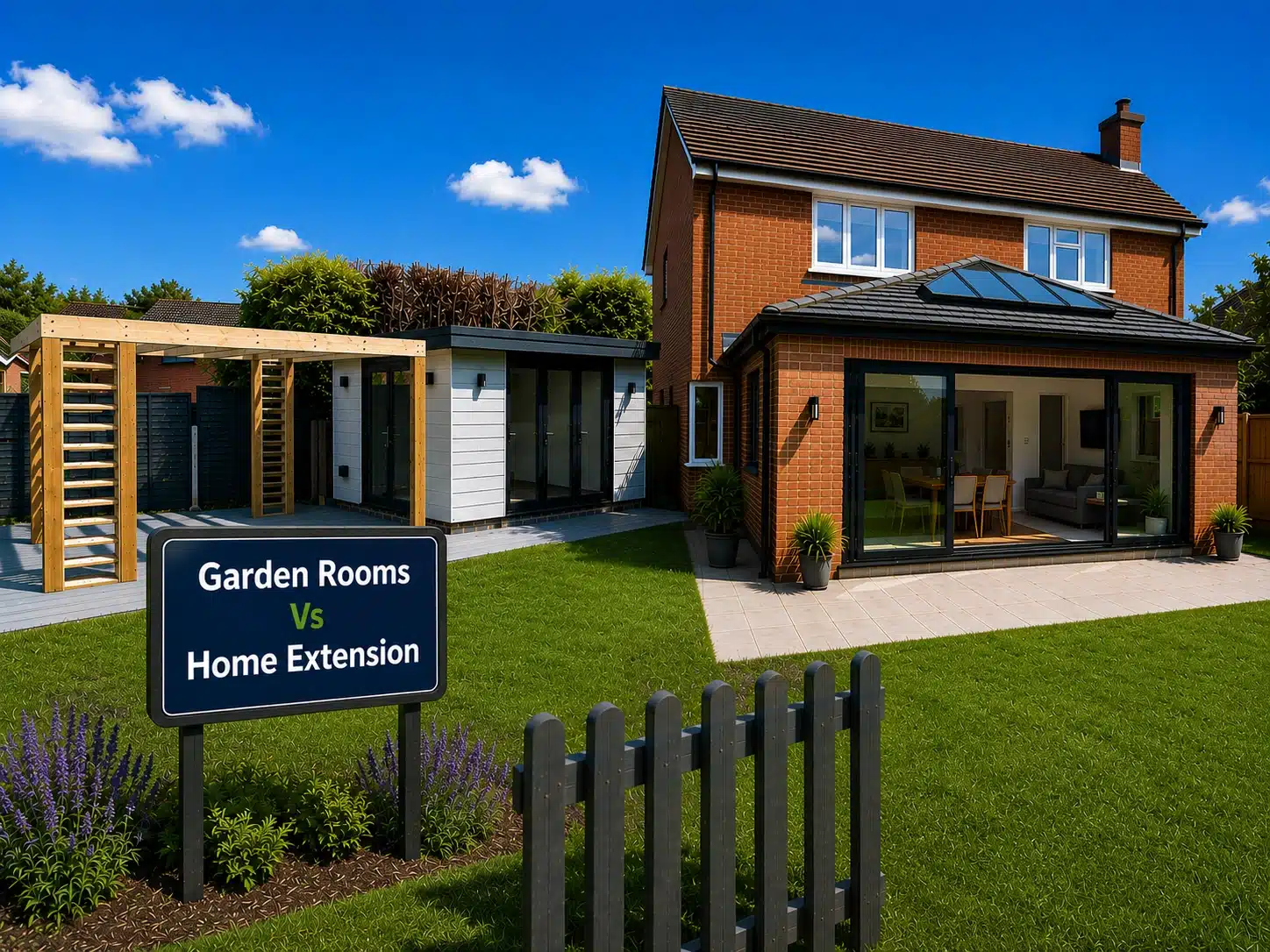
Garden Room vs Home Extension | What Are We Actually Comparing?
Let’s get this straight from the off. When we talk about a garden room vs home extension, we are comparing two very different approaches to gaining extra space at home.
A home extension, whether it’s a rear extension, side return, or a full double-storey build, physically expands the footprint of your existing house. It connects directly to the main structure and requires serious construction work: foundations, structural engineers, party wall agreements if neighbours are involved, full planning permission in most cases, and months of building work.
A garden room, on the other hand, is a standalone structure built within your existing garden. Modern garden rooms, like the ones we build at Sanctuary Garden Rooms, are fully insulated, plumbed if needed, electrified, and finished to a standard that blurs the line between ‘garden outbuilding’ and ‘proper room’. They are used as home offices, gyms, therapy rooms, studios, teen dens, and even self-contained annexes.
So, the core question isn’t really ‘which is bigger?’ It’s which gives you more value, financially, practically, and in your daily life.
Planning Permission: Garden Room vs Home Extension | Which One Is Simpler?
This is where a lot of people underestimate the garden room vs home extension comparison.
Home Extension Planning Rules
Most home extensions require full planning permission unless they fall within very specific Permitted Development limits, and even then, you often need a Lawful Development Certificate to confirm you are within those limits before you sell.
Rear single-storey extensions can sometimes be built under Permitted Development, but there are strict limits on how far they extend, their height, and how much of the original garden they cover. Double-storey extensions almost always require full planning permission, which means a minimum of eight weeks’ wait, neighbour consultations, and no guarantee of approval.
Garden Room Planning Rules
Here is where garden rooms have a genuine edge. In most cases, a garden room qualifies as a Permitted Development outbuilding, meaning no planning permission required at all.
The key rules to be aware of: the garden room must be single storey, no more than 2.5m high if within 2m of a boundary (or up to 4m with a dual-pitched roof further away), and cannot cover more than 50% of the land around the original house. It also can’t be used as ‘a separate dwelling’, though it can function as a home office, studio, or leisure room without issue.
Listed buildings and properties in conservation areas have different rules, so always worth checking. But for the majority of UK homeowners, a garden room goes up with no planning headaches at all.
Garden Room vs Home Extension | Which Adds More Value to Your Property in the UK?
The short answer: both can add value. The longer answer involves understanding how estate agents and buyers actually think.
Home Extension Value
A well-executed home extension, particularly one that adds a bedroom or significantly increases floor space, can add substantial value to a UK property. Research from Nationwide and various estate agent surveys consistently suggests a well-done rear extension can add 10–20% to property value.
But here’s the caveat: it has to be done well. Poor build quality, unsympathetic design, or an extension that eats up all the garden can actually put buyers off. Garden space is increasingly valued by UK buyers, especially post-pandemic.
Garden Room Value
Garden rooms are increasingly recognised by UK estate agents and buyers as a genuine value-add, particularly for properties where buyers are likely to work from home or want multi-purpose space. A quality garden room vs home extension comparison isn’t purely square-footage, it’s about perceived lifestyle.
Savills and various Rightmove surveys have highlighted ‘home office’ and ‘outbuilding/studio’ as features buyers actively search for. A garden room by Sanctuary Garden Room, finished to a high specification, signals to buyers: this property has usable, versatile space, and you can move in on day one without building work.
Value-wise, a quality garden room can add between £5,000 and £20,000+ to a property’s perceived worth depending on the spec, location, and the market.
The key difference? A home extension is likely to add more in pure pound-for-pound resale value if done properly. But a garden room often delivers a better return on investment because the outlay is so much lower, and it doesn’t disrupt your life for six months in the process.
The Lifestyle Argument | And Why It Matters More Than You Think
Most people aren’t making this decision purely on ROI spreadsheets. They are making it because they need more space, they are fed up with driving to work, or they want somewhere quiet that isn’t the dining room table.
A home extension changes the interior of your home. That’s great if you want an open-plan kitchen or an extra bedroom. But the build process is genuinely disruptive, dusty, noisy, and often slower than anticipated. You might need to move out temporarily. You will be project-managing builders for months.
A garden room? From order to completion at Sanctuary Garden Rooms, we are typically talking about a matter of weeks. The structure goes up, gets connected, and then it’s yours. No living in a building site. No replastering every room you walk through.
Moreover, there is something to be said for having a physical separation between where you live and where you work, or exercise, or create. A garden room provides that in a way a home extension, by definition, cannot.
Who Should Choose a Garden Room?
You are probably better suited to a garden room if:
You need a home office, studio, gym, or creative space rather than additional bedrooms
You want the project done quickly and with minimal disruption
You are not in a conservation area and your garden has sufficient space
You value having a distinct, separate space away from the main house
You want something that appeals to the growing number of home-working buyers when you sell
Who Should Choose a Home Extension?
A home extension makes more sense if:
You need additional bedrooms, garden rooms can't serve as sleeping accommodation without planning permission
You want to significantly increase the square footage of your main house
You have a larger budget and are confident in a lengthy project
Your garden is limited and you can't afford to lose the outdoor space
You're in a higher-value area where square footage directly correlates with sale price
Key Benefits of a Garden Room vs Home Extension at a Glance
Garden Room Benefits
Faster build, weeks, not months
Lower cost
No planning permission required in most UK properties
Separate, peaceful space away from the main house
Strong appeal to home-working buyers
Minimal disruption to daily life
Home Extension Benefits
Larger potential resale value uplift in premium markets
Adds square footage counted in official floor area
Can add bedrooms, garden rooms generally cannot
Fully integrated with the main home
Sanctuary Garden Rooms: Built for Real Life
At Sanctuary Garden Rooms, we design and build premium garden rooms across the UK, fully insulated, fully wired, and finished to a standard that makes the garden room vs home extension debate feel a bit one-sided, frankly.
Whether you are after a sleek home office, a fitness studio, a music room, or something completely bespoke, we will work with you from the first conversation through to the final power socket. No project management stress. No months of waiting.
If you are wondering whether a garden room is right for your plot and your plans, the easiest thing to do is get in touch. We offer free consultations and can advise on everything from positioning to specification.
Garden Room vs Home Extension | Conclusion
If maximum resale value in absolute pound terms is your only goal, and you have the budget and the stomach for a lengthy build, a home extension might edge ahead.
But if you want great space, less hassle, a faster turnaround, a lower price tag, and a feature that genuinely appeals to modern buyers, the garden room vs home extension comparison lands pretty firmly on the garden room side.
The best decision, as always, depends on your specific property, your budget, your timeline, and what you actually need the space for. But don’t assume that ‘bigger and more permanent’ always means ‘better investment’. Sometimes the smartest move is the one that costs less, takes less time, and still makes buyers queue at the door.
Ready to explore what a garden room could look like on your property?
People Also Read:
Does a garden room add value to my UK property?
Yes, a quality garden room can add between £5,000 and £20,000+ to your property's perceived value depending on location, specification, and buyer demand. It's particularly appealing to buyers who work from home.
Is a garden room cheaper than a home extension?
Typically, yes, significantly so. A quality garden room in the UK costs between £15,000 and £40,000, while a home extension often runs £45,000 to £80,000+ once all associated costs are included.
Do I need planning permission for a garden room?
In most cases, no. Garden rooms usually qualify as Permitted Development under UK planning rules, meaning no planning application is required. There are size and positioning rules to follow, and listed buildings or conservation area properties may have different requirements.
How long does it take to install a garden room compared to a home extension?
A garden room from Sanctuary Garden Rooms typically takes a matter of weeks from order to completion. A home extension generally takes several months, often six months or more when factoring in planning, groundworks, and the build itself.
Which adds more value, a garden room or a home extension?
A well-executed home extension can add more in absolute terms if it adds bedrooms or significant floor space. However, a garden room often delivers a better return on investment relative to its cost, and increasingly appeals to UK buyers who prioritise flexible, home-working-friendly space.